Crop production faces threats from plant pathogens. Traditional disease-resistance breeding relies heavily on natural plant resistance genes that encode immune receptors adapted to particular pathogens. However, rapidly evolving pathogens frequently overcome these natural defenses, and the limited diversity of naturally occurring immune receptors makes it difficult to develop crops with durable resistance.
Now, a team led by Prof. GAO Caixia from the Institute of Genetics and Developmental Biology (IGDB) of the Chinese Academy of Sciences has developed a multi-step process for on-demand design of synthetic plant immune receptors (SPIRs), which can recognize diverse plant pathogens.
The study was published in
Science on July 23.
The immune receptors at the focus of this study—intracellular nucleotide-binding leucine-rich repeat receptors (NLRs)—mainly detect pathogens through large, highly repetitive leucine-rich repeat domains that are difficult to engineer. To counter this problem, the researchers exploited a distinct class of NLRs that recognize pathogens through compact, modular integrated decoy (ID) domains, which can be readily replaced with newly designed pathogen-recognition modules.
Using AI-assisted protein design tools such as AlphaFold 3 and BindCraft, the researchers designed de novo proteins that specifically bind pathogen proteins. They then inserted these designed proteins into the rice immune receptor Pikm-1 by replacing its native ID domain, yielding SPIRs with customized recognition specificities.
The researchers used this process to design 391 SPIRs, which targeted proteins from a broad range of plant pathogens, including viruses, bacteria, fungi, and oomycetes. Of these, 71 (18.2%) recognized their intended targets and activated immune signaling, demonstrating that AI-assisted de novo protein design can generate functional plant immune receptors.
To further improve receptor performance, however, the researchers developed a high-throughput platform named geminivirus replicon–assisted in planta directed evolution (
GRAPE) to optimize previously developed SPIRs. This optimization significantly enhanced immune activity and reduced unwanted autoactivation. Transgenic plants expressing optimized SPIRs showed effective resistance to viral infection, highlighting the potential of the technology for crop improvement.
Unlike resistance breeding that depends on naturally occurring resistance genes, the SPIR platform enables the customized design of immune receptors that can recognize entirely new pathogen targets. In principle, SPIRs targeting proteins from emerging pathogens can now be generated within weeks, providing a rapid and versatile strategy for protecting crops against evolving disease threats.
This work establishes a framework for programmable plant immunity, in which receptors can be designed, optimized, and deployed on demand. Programmable synthetic immunity may become a general strategy for developing next-generation disease-resistant crops and strengthening global food security.
Prof. GAO Caixia
 CAS
CAS
 中文
中文



.png)
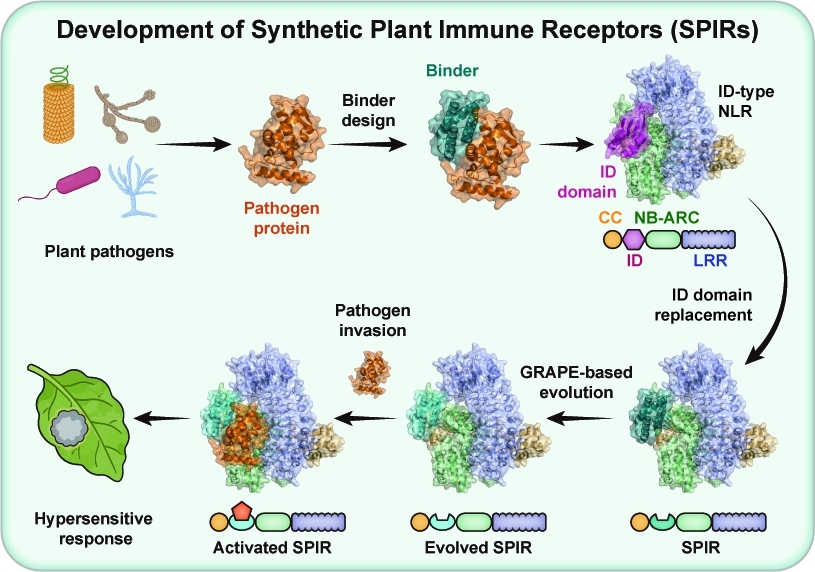 Graphical representation of SPIR development (Image by IGDB)Contact:Prof. GAO CaixiaInstitute of Genetics and Developmental Biology, Chinese Academy of SciencesEmail: cxgao@genetics.ac.cn
