With the global population growth and climate change posing escalating threats to crop production, the current food system is unlikely to be sufficient to meet future demand. Although more than 12,000 plant species are edible, global agriculture remains reliant on a narrow set of crops, with roughly 30 species supplying 95% of the world’s calories. This reliance has resulted in a highly homogenized and increasingly vulnerable food system.
The research was published in Nature Communications (https://www.nature.com/articles/s41467-025-66020-3) on November 26.
Orphan crops, including grain species like fonio and tef, legumes such as cowpea, as well as regionally important vegetables, fruits, fiber, and oil crops, are valued for their stress tolerance, rich nutritional profiles, and species diversity. Mainstreaming orphan crops could improve nutritional security, strengthen climate resilience, and expand agro-biodiversity at regional and global scales. However, due to limited investment in research and the absence of innovative breeding systems, many orphan crops lack high-yielding, high-quality, and stable superior varieties, limiting their broader adoption.
In this study, Prof. XU Cao and his team proposed an integrated DSAP strategy, combining De novo domestication, Speed breeding, and AI-empowered phenomics, to accelerate orphan crop breeding. De novo domestication uses genome editing to rapidly introduce desirable traits while preserving stress resilience. Speed breeding leverages controlled environments and extended photoperiods to shorten generation time. AI-empowered phenomics enables high-throughput and precise selection of elite lines. Together, this integrated framework can accelerate germplasm innovation, generation turnover, and variety evaluation, addressing key bottlenecks in traditional crop breeding.
The authors emphasized that improving orphan crops could offer a multifaceted strategy to enhance food diversity, nutritional quality, and environmental sustainability. With sustained investment in scientific research and supportive policies, orphan crops have the potential to become important components of future sustainable food systems.
Figure. Schematic of DSAP breeding strategy (Image by IGDB)
Contact:
Prof. XU Cao
Institute of Genetics and Developmental Biology, Chinese Academy of Sciences
Email: caoxu@genetics.ac.cn
 CAS
CAS
 中文
中文



.png)
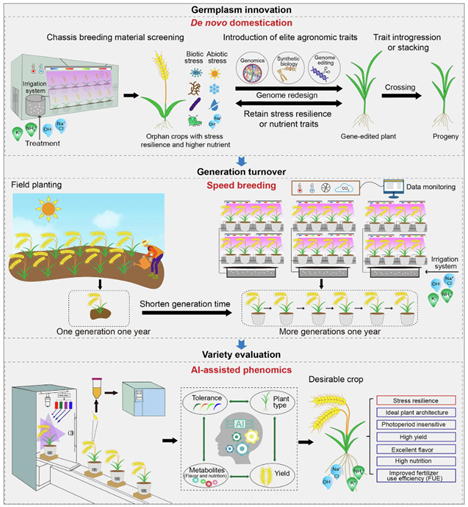 Figure. Schematic of DSAP breeding strategy (Image by IGDB)Contact:Prof. XU CaoInstitute of Genetics and Developmental Biology, Chinese Academy of SciencesEmail: caoxu@genetics.ac.cn
