An efficient plant regeneration system is a prerequisite for genetic transformation and genome editing in crops. However, in major crops such as wheat, regeneration efficiency exhibits strong genotype dependence: model cultivars commonly used for transformation (e.g., Fielder) display high regeneration efficiency, whereas elite cultivars widely used in agricultural production (such as Jimai22 and Aikang58) are often recalcitrant to regeneration. This genotype dependence constrains the genetic improvement of agronomically important varieties.
Recently, the research group of XIAO Jun at the Institute of Genetics and Developmental Biology, Chinese Academy of Sciences, compared gene expression profile, chromatin accessibility dynamics, and transcriptional regulatory networks (TRNs) in Fielder (regenerable) and Jimai22 (recalcitrant). The results showed that from DAI3 to DAI6, Fielder exhibits pronounced chromatin accessibility remodeling and transcriptional reprogramming, activating genes involved in auxin signaling and meristem development. In contrast, JM22 displays limited transcriptional activation, with induced genes mainly associated with stress-response pathways. Comparative TRN analysis further revealed that Fielder possesses a more complex and regeneration-focused regulatory network.
The study further identified TaSCR, a Fielder-specific core transcription factor, as a central regulator linking auxin signaling to meristem-related genes expression. Auxin indirectly activates TaSCR through TaARF22 and TaGATA15, after which TaSCR directly induces downstream genes such as TaLBD17 and TaWOX5, thereby promoting cell fate transition.
Functional assays demonstrated that overexpression of TaSCR or TaLBD17 significantly improves callus induction, differentiation, and transformation efficiency in both Fielder and recalcitrant cultivars (Jimai22, Aikang58, and Kenong199). Notably, TaSCR overexpression did not cause obvious negative effects on seed development.
This work elucidated the molecular mechanisms underlying regeneration efficiency differences among wheat genotypes and identifying key regulators of wheat regeneration, which provided insights to overcome current bottlenecks in crop genetic transformation.
The research results were published online on December 16, 2025, in The Cell Reports with the title "Chromatin accessibility and TaSCR-TaLBD17 circuitry shape genotypic regeneration capacity in wheat" (DOI: 10.1016/j.celrep.2025.116743).
Figure. Chromatin accessibility and TaSCR-TaLBD17 circuitry shape genotypic regeneration capacity in wheat (Image by IGDB)
Contact:
Dr. XIAO Jun
Institute of Genetics and Developmental Biology, Chinese Academy of Sciences
Email: jxiao@genetics.ac.cn
 CAS
CAS
 中文
中文



.png)
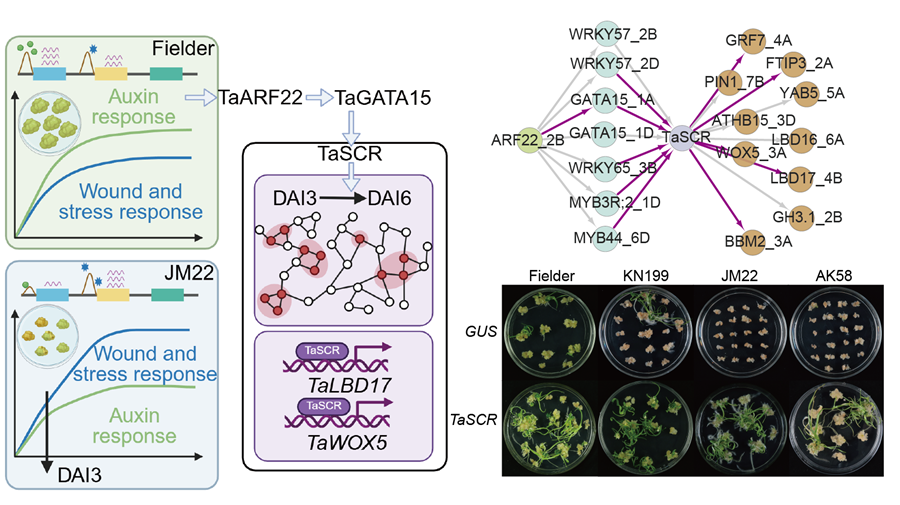 Figure. Chromatin accessibility and TaSCR-TaLBD17 circuitry shape genotypic regeneration capacity in wheat (Image by IGDB)Contact:Dr. XIAO JunInstitute of Genetics and Developmental Biology, Chinese Academy of SciencesEmail: jxiao@genetics.ac.cn
