The co-evolution of mitochondria and the nucleus established constant mito-nuclear communication that is essential for both cellular and organismal homeostasis. As a cellular signaling hub, mitochondria initiate retrograde signaling to relay their functional state to the nucleus when facing stress or perturbations, thereby triggering transcriptional programs to reestablish cellular homeostasis. Recent studies have revealed that this communication extends beyond cellular boundaries, coordinating systemic adaptation, stress resilience, and the aging process across tissues.
This work entitled “Mito-nuclear communication: from cellular responses to organismal health” (DOI:10.1016/j.molcel.2026.01.001) has been published on February 5th.
Firstly, the authors outline cell-autonomous mitochondrial stress response pathways, with a focus on the mechanisms of the mitochondrial unfolded protein response (UPRmt) and the mitochondrial integrated stress response (ISRmt). The article details the mechanistic differences of UPRmt between C. elegans and mammals and provides an in-depth analysis of the OMA1-DELE1-HRI axis. This axis serves as a critical junction connecting mitochondrial dysfunction to the cytosolic ISR network, finely tuning cell fate and metabolic reprogramming under distinct stress conditions.
Furthermore, the review constructs a framework for systemic mito-nuclear communication organized around four dimensions: sensing, broadcasting, modulation, and response. The authors summarize how local mitochondrial stress signals are converted into secreted mitokines, which are transmitted to distal tissues via neural circuits and the endocrine system. The review discusses how the nervous and reproductive systems integrate these signals to balance the trade-offs between growth, reproduction, and longevity. It further emphasizes the significance of this systemic communication in coordinating metabolic flexibility, innate immunity, and transgenerational inheritance.
Finally, the authors propose future directions, suggesting that precise intervention of mito-nuclear communication could serve as potential therapeutic strategies for treating metabolic diseases and delaying aging.
Figure. Systemic mito-nuclear communication coordinates organismal physiology (Image by IGDB)
This work is supported by the National Key Research and Development Program of China, the National Natural Science Foundation of China, the CAS Project for Young Scientists in Basic Research and the New Cornerstone Science Foundation through the XPLORER PRIZE.
Contact:
Dr. TIAN Ye
Institute of Genetics and Developmental Biology, Chinese Academy of Sciences
Email: ytian@genetics.ac.cn
 CAS
CAS
 中文
中文



.png)
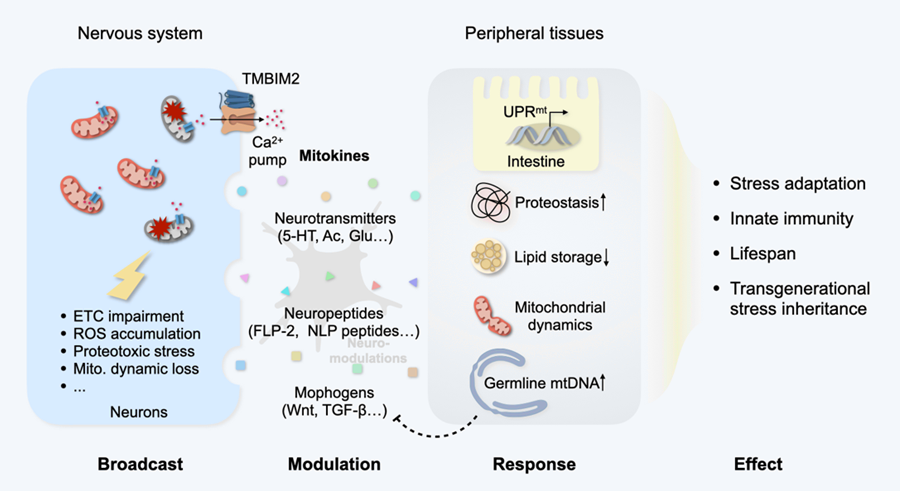 Figure. Systemic mito-nuclear communication coordinates organismal physiology (Image by IGDB)This work is supported by the National Key Research and Development Program of China, the National Natural Science Foundation of China, the CAS Project for Young Scientists in Basic Research and the New Cornerstone Science Foundation through the XPLORER PRIZE.Contact:Dr. TIAN YeInstitute of Genetics and Developmental Biology, Chinese Academy of SciencesEmail: ytian@genetics.ac.cn
