The nuclear envelope (NE) is a dynamic and selective barrier that organizes genome function and nucleocytoplasmic communication, and its structural deterioration is a hallmark of aging associated with diverse human diseases. While NE integrity is maintained by coordinated regulation of the nuclear lamina, cytoskeletal forces, and membrane composition, most studies have focused on mitotic NE dynamics, leaving the mechanisms that preserve NE structure in non-dividing aging cells poorly understood. Mitochondria are central hubs of metabolic and signaling activity, and mild mitochondrial perturbations can promote cellular homeostasis and longevity through adaptive stress responses; however, whether mitochondrial redox signals directly regulate NE integrity during aging, and how this occurs, has remained unclear.
In a study published in Nature Metabolism, researchers from the Institute of Genetics and Developmental Biology, Chinese Academy of Sciences, report a previously unrecognized mechanism by which mitochondrial superoxide acts as a key signaling molecule to preserve NE integrity and delay aging. Using the nematode Caenorhabditis elegans as a model system, the study demonstrates that mitochondrial redox signaling regulates lipid metabolism to protect nuclear structure over the lifespan.
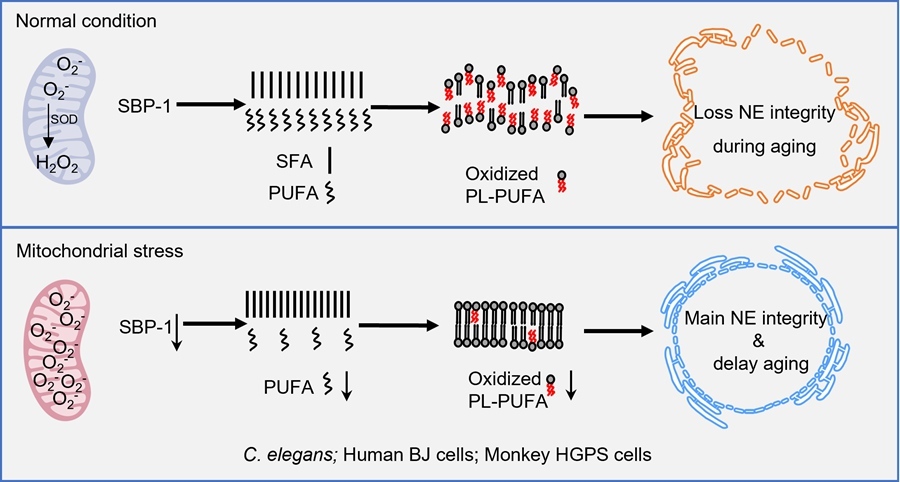
The researchers found that reducing mitochondrial electron transport chain (ETC) activity in C. elegans significantly preserves NE integrity during aging. This protective effect depends on mitochondrial superoxide generated during development. Mechanistically, mitochondrial superoxide suppresses the activity of SBP-1, the nematode ortholog of mammalian SREBP, leading to reduced synthesis of unsaturated fatty acids. The resulting decrease in lipid peroxidation limits age-associated damage to the NE, thereby maintaining nuclear structure and function.
Importantly, direct interventions that inhibit lipid peroxidation were sufficient to preserve NE integrity, extend lifespan in C. elegans, and alleviate aging-associated cellular defects in human fibroblasts and in monkey cell models of Hutchinson–Gilford progeria syndrome. These findings indicate that lipid peroxidation is a key downstream effector linking mitochondrial redox signaling to nuclear aging.
This work identifies mitochondrial superoxide as a protective developmental signal that programs long-term NE stability. By establishing precise control of lipid peroxidation as a conserved strategy to delay nuclear aging, the study highlights redox–lipid crosstalk as a promising therapeutic axis for promoting healthy aging and combating age-related diseases.
This study entitled “Mitochondrial Superoxide Regulates Nuclear Envelope Integrity and Aging via Redox-Mediated Lipid Metabolism” was published in Nature Metabolism (https://www.nature.com/articles/s42255-026-01452-9) on February 3rd, 2026.
This research was supported by the National Key Research and Development Program of China, the National Natural Science Foundation of China, CAS Project for Young Scientists in Basic Research, and young investigator teams, and the New Cornerstone Science Foundation through the XPLORER PRIZE, etc.
Mitochondrial redox-lipid crosstalk safeguards NE integrity during aging (Image by IGDB)
Contact:
Dr. TIAN Ye
Institute of Genetics and Developmental Biology, the Chinese Academy of Sciences
Email: ytian@genetics.ac.cn
 CAS
CAS
 中文
中文



.png)
 Mitochondrial redox-lipid crosstalk safeguards NE integrity during aging (Image by IGDB)Contact:Dr. TIAN YeInstitute of Genetics and Developmental Biology, the Chinese Academy of SciencesEmail: ytian@genetics.ac.cn
