Aging is a complex biological process jointly regulated by genetics, the environment, and the microbiome. While current anti-aging research often relies on individuals with a single genetic background, this approach overlooks the extensive genetic diversity present in natural populations. Understanding how host genetic variations dictate the outcomes of microbial interventions remains a critical challenge in achieving precise micro-ecological health solutions.
In a study published in Aging Cell (DOI: 10.1111/acel.70418), researchers from the Institute of Genetics and Developmental Biology, Chinese Academy of Sciences, systematically revealed that the host's capacity to resist oxidative stress is a core mechanism determining whether microbial interventions extend lifespan or accelerate aging.
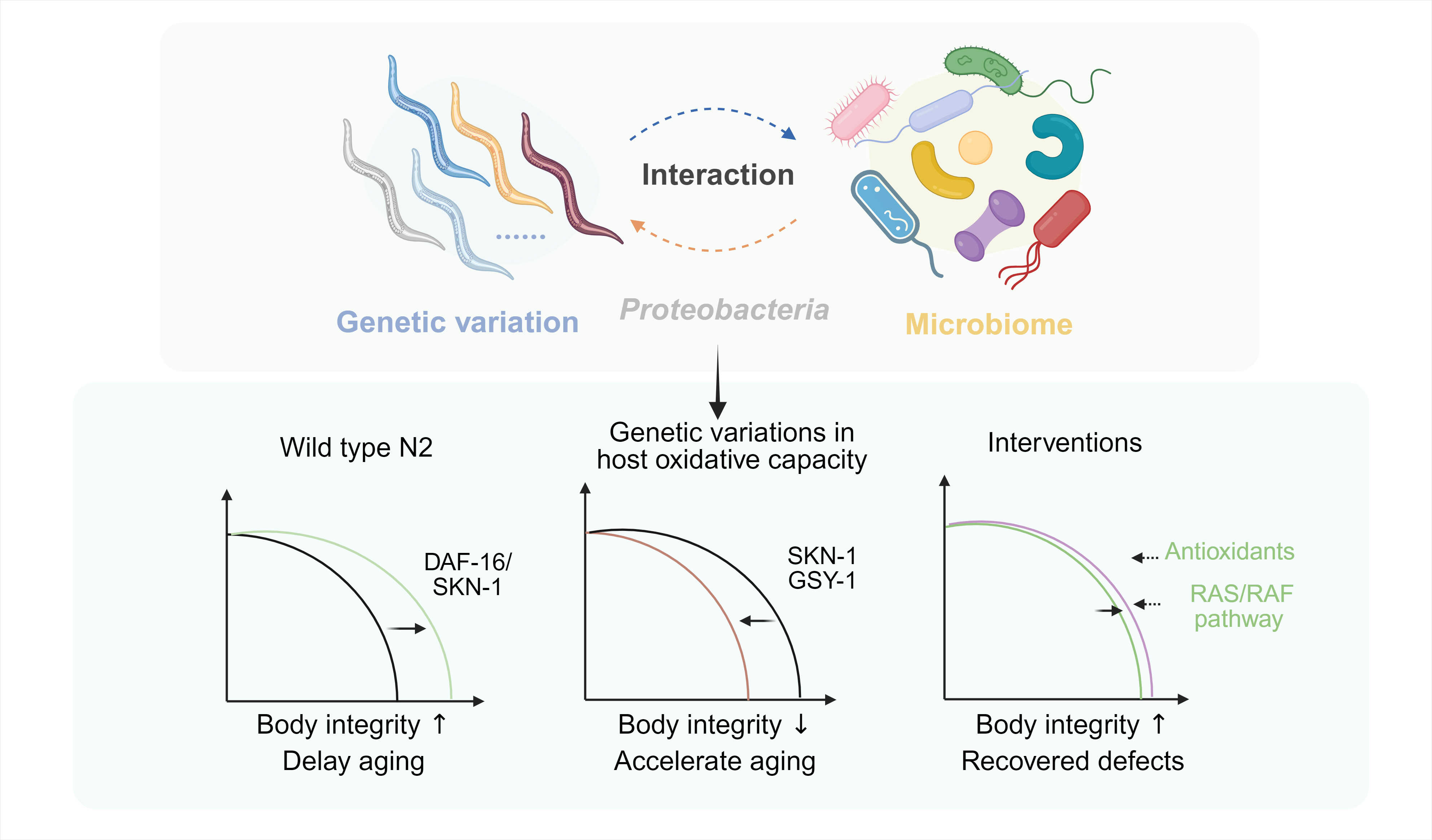
Building on previous findings where specific soil bacteria were shown to extend the lifespan of Caenorhabditis elegans, the researchers expanded their screening from the standard wild-type background to include mutants lacking key aging regulators. The results were striking: the regulation of lifespan by microbes exhibited strong genetic dependency. Strains such as Variovorax sp. Root473, which acted as beneficial "probiotics" in wild-type nematodes, became lethal "killers" in mutants lacking the oxidative stress transcription factor skn-1. In these compromised hosts, the bacteria significantly shortened lifespan and caused severe damage to the organism's barrier function.
To investigate how natural genetic variation regulates this process, the team screened 38 wild C. elegans isolates from around the world. They observed significant heterogeneity in response to Root473: some strains displayed a long-lived response similar to the wild type, while others were sensitive and short-lived. Through genetic analysis, the researchers identified a specific point mutation in the glycogen synthase gene gsy-1. This mutation leads to glycogen metabolism defects and disrupts the host's redox buffering capacity, rendering specific individuals highly vulnerable to microbial interventions.
Mechanistically, the study found that Variovorax sp. Root473 induces an increase in host Reactive Oxygen Species (ROS) levels. Individuals with skn-1 deletion or gsy-1 mutation features lack sufficient oxidative stress resistance, leading to imbalance and premature aging under pressure, whereas individuals with intact antioxidant systems can effectively defend themselves and achieve longevity. Furthermore, the team demonstrated that external supplementation with antioxidants or genetic inhibition of the EGF-RAS-MAPK signaling pathway could rescue the lifespan defects and barrier damage in sensitive individuals.
This research provides a scientific explanation for individual differences in microbiome responses, emphasizing the importance of personalized approaches in micro-ecological interventions. And it was supported by the National Key Research and Development Program of China, the National Natural Science Foundation of China, CAS Project for Young Scientists in Basic Research, and young investigator teams, and the New Cornerstone Science Foundation through the XPLORER PRIZE, etc.
Host oxidative response capacity determines the longevity outcomes of microbial interventions (Image by IGDB)
Contact:
Dr. TIAN Ye
Institute of Genetics and Developmental Biology, the Chinese Academy of Sciences
Email: ytian@genetics.ac.cn
 CAS
CAS
 中文
中文



.png)
 Host oxidative response capacity determines the longevity outcomes of microbial interventions (Image by IGDB)Contact:Dr. TIAN YeInstitute of Genetics and Developmental Biology, the Chinese Academy of SciencesEmail: ytian@genetics.ac.cn
