The immune system operates with a critical baseline known as basal expression, or the "immune threshold." When this threshold is set too high, the plant risks autoimmune dysfunction; when set too low, it cannot mount a timely defense against pathogens. In soybeans, which carry a vast repertoire of disease-resistance genes and a genome composed of more than 50% transposons, the mechanisms that govern this threshold have long remained elusive.
A study published in The Plant Cell (DOI:10.1093/plcell/koag033) by Dr. WANG Yuan’s group at the Institute of Genetics and Developmental Biology, Chinese Academy of Sciences (CAS), now provides an answer.
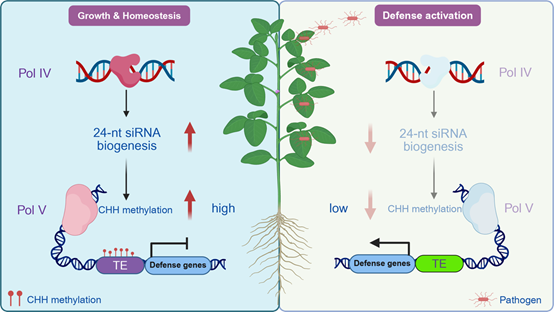
Their findings revealed that Long Terminal Repeats (LTR) retrotransposon often dismissed as "selfish DNA" or genomic "fossils" are repurposed by the plant’s RNA-directed DNA methylation (RdDM) pathway to serve as a precise regulatory "dial" for immune gene expression.
The researchers identified an epigenetic control unit within the soybean genome. LTR transposon fragments are frequently positioned adjacent to key immune hubs, including TNL-type receptor genes and EDS1/SAG101 signaling components. Through the RdDM pathway, the plant actively applies methylation marks to these transposons, maintaining adjacent defense genes in a low-level, "standby" state.
When this epigenetic restraint is disrupted, nearby immune genes become constitutively activated even in the absence of pathogens, leading to widespread autoimmune activation and severely stunted plant growth.
Ultimately, these findings demonstrate that the transposon module is essential for maintaining immune homeostasis, keeping large suites of defense genes poised at the ready while preventing harmful autoimmunity.
Contact:
Dr. WANG Yuan
Institute of Genetics and Developmental Biology, Chinese Academy of Sciences
Email: yuan.wang@genetics.ac.cn
 CAS
CAS
 中文
中文



.png)