Genetic bottlenecks caused by intensive domestication and selective breeding have become a major constraint on sustainable agricultural development, limiting genetic diversity and reducing the availability of useful traits for crop improvement.
Now, a research team led by Prof. XU Cao at the Institute of Genetics and Developmental Biology (IGDB), Chinese Academy of Sciences, has developed an innovative cross-species gene repurposing strategy that offers a new solution to this challenge.
The research was published on March 28 in Advanced Science (DOI:10.1002/advs.202517112).
The study demonstrates that genes considered undesirable in one species can be transformed into valuable traits in another, providing a new framework for personalized, cross-species breeding guided by evolutionary developmental biology (evo-devo).
Floral organ senescence and abscission are agriculturally important traits, but their breeding value varies dramatically depending on the crop. In fruit crops such as tomato, delayed petal shedding after pollination is undesirable because persistent floral organs continue to consume nutrients, create humid microenvironments that favor pathogen infection, and may leave scars on fruit surfaces that reduce commercial quality. In contrast, in ornamental plants, especially cut flowers, delayed senescence and abscission are highly desirable traits, as they extend floral longevity, improve shelf life, and enhance market value. This contrast creates an opportunity to rethink and repurpose genes previously regarded as unfavorable.
Using tomato as a model system, the researchers uncovered a previously unknown molecular mechanism regulating floral organ senescence and abscission. They found that three SlBOP proteins undergo liquid-liquid phase separation (LLPS) and interact with the transcription factor TFAM1 to form transcriptional condensates. These condensates activate the abscission-related gene SlATH1, thereby precisely controlling the differentiation of abscission zone cells. The petal of Slbop1/2/3 tfam1 mutant exhibited non-abscission and delayed senescence.
Building on these findings, the team applied the knowledge to petunia, an ornamental species in Solanaceae family. By precisely editing the homologous PhBOP genes, the researchers generated new petunia germplasm with significantly improved ornamental traits. The Phbop1/2/3 triple mutant showed extended flowering period of approximately one week, enlarged corolla diameter and reduced corolla height, improving overall ornamental value. Additionally, pollen-free flowers, making them more suitable for allergy-sensitive consumers. These traits significantly enhance the commercial value of flowers, particularly for the cut-flower market.
This work provides a compelling example of cross-species genetic redefinition, in which mutations that are undesirable in tomato become advantageous in petunia. The findings challenge the traditional binary classification of genes as simply “useful” or “useless”. By integrating evo-devo principles with species-specific breeding goals, the study establishes a new conceptual framework for revitalizing existing genetic resources and thus mitigating genetic bottlenecks in breeding.
The researchers emphasize that this personalized cross-species breeding strategy holds broad potential for future agricultural innovation, enabling scientists to unlock hidden value in genes that were previously discarded during conventional selection.
Figure. Mechanisms of programmed abscission in floral organs and their cross-species applications. (Image by IGDB)
Prof. XU Cao
Institute of Genetics and Developmental Biology, Chinese Academy of Sciences
Email: caoxu@genetics.ac.cn
 CAS
CAS
 中文
中文



.png)
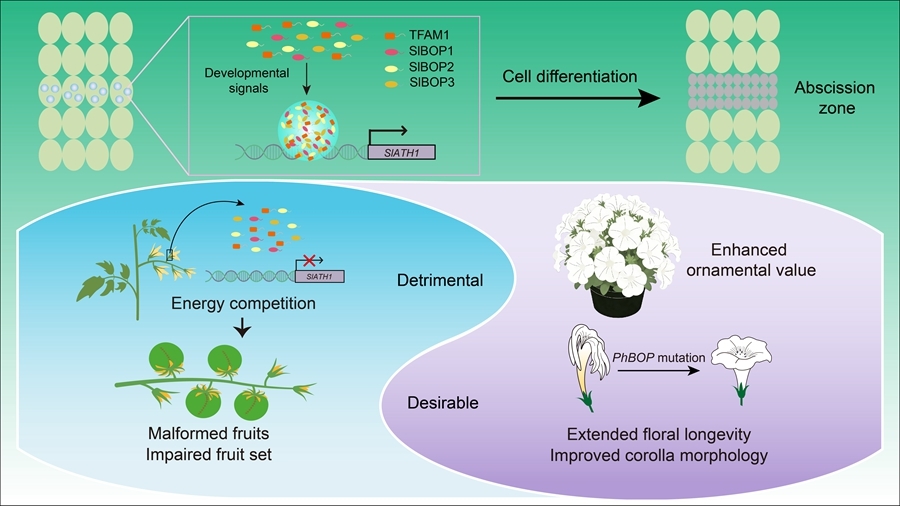 Figure. Mechanisms of programmed abscission in floral organs and their cross-species applications. (Image by IGDB)Prof. XU CaoInstitute of Genetics and Developmental Biology, Chinese Academy of SciencesEmail: caoxu@genetics.ac.cn
