Drought is increasingly recognized as one of the most severe environmental threats to global food security. Although rhizosphere microorganisms are known to contribute to plant stress tolerance, whether microbial diversity itself directly enhances crop drought resistance has remained largely unresolved.
Recently, a research team led by Prof. WEI Gehong and Prof. JIAO Shuo at Northwest A&F University published a research article in Cell Host & Microbe, revealing for the first time that rhizosphere microbial diversity enhances soybean drought resilience by triggering the root-specific secretion of 2-naphthoic acid, which recruits and activates the beneficial bacterium Sinorhizobium CS204. In recognition of the significance of this work, Dr. FENG Jian’s team from the Institute of Genetics and Developmental Biology, Chinese Academy of Sciences, was invited to publish a Preview article entitled “Diversity Recruits Resilience via Metabolite Signaling” in the same issue of Cell Host & Microbe.
In the Preview article, the authors systematically summarized the major conceptual advances of the study and highlighted that the work establishes, for the first time, a complete mechanistic framework linking “microbial diversity–host metabolic reprogramming–beneficial microbe recruitment–enhanced drought resilience.” Using a dilution-to-extinction strategy, the original study constructed soil microbial communities with different levels of complexity and demonstrated that microbial diversity itself is a direct determinant of soybean drought recovery capacity, rather than merely a correlated ecological feature. Integrated metabolomic and transcriptomic analyses further revealed that highly diverse microbial communities suppress excessive stress responses under drought conditions, enabling plants to maintain a more precise and energy-efficient metabolic strategy.
The Preview particularly emphasized the central role of 2-naphthoic acid in mediating this process. Under high-diversity microbiome conditions, soybean roots specifically accumulated and secreted 2-naphthoic acid, which not only served as a chemotactic signal to recruit the beneficial bacterium Sinorhizobium CS204, but also directly regulated microbial nitrogen metabolism-related enzyme activities, thereby coordinating both microbial recruitment and functional activation.
Based on these findings, the Preview proposed a hierarchical regulatory model in which rhizosphere microbial diversity acts as an upstream ecological signal that reshapes root exudate profiles, selectively enriches key functional microbial groups, and ultimately converts community-level complexity into host-usable stress resilience. This conceptual framework moves the field beyond descriptive correlations and advances plant-microbiome research toward a more predictive and designable stage.
The article also highlighted the important agricultural implications of this work. On one hand, preserving soil biodiversity itself may represent an effective ecological strategy for improving crop stress tolerance. On the other hand, 2-naphthoic acid and related compounds may serve as promising molecular targets for developing next-generation synthetic microbial inoculants, biostimulants, and rhizosphere microbiome engineering technologies for crop improvement under environmental stress.
This work was supported by the Biological Breeding-National Science and Technology Major Project.
Microbial diversity programs plant metabolic responses and recruits beneficial
microbes to enhance drought resilience in soybeans. (Image by IGDB)
Contact:
Dr. FENG Jian
Institute of Genetics and Developmental Biology, Chinese Academy of Sciences
Email: jfeng@genetics.ac.cn
 CAS
CAS
 中文
中文



.png)
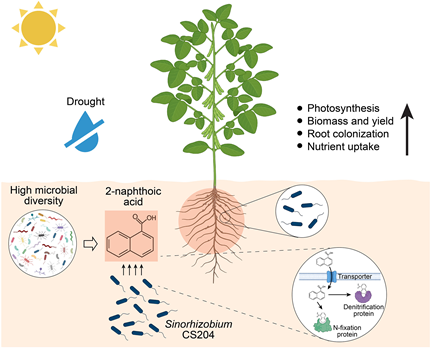 Microbial diversity programs plant metabolic responses and recruits beneficialmicrobes to enhance drought resilience in soybeans. (Image by IGDB)Contact:Dr. FENG JianInstitute of Genetics and Developmental Biology, Chinese Academy of SciencesEmail: jfeng@genetics.ac.cn
