Iron (Fe) is an essential micronutrient for plant growth and development. However, in alkaline or calcareous soils widely distributed across the globe, iron predominantly exists in the form of highly insoluble ferric oxides, leading to severe "iron deficiency chlorosis" in crops, which significantly impacts yield and quality. To cope with this challenge, non-graminaceous plants (e.g., Arabidopsis thaliana) have evolved a "Strategy I" iron uptake mechanism, in which root-specialized metabolites, particularly catecholic coumarins, play a crucial role. These coumarins are secreted into the rhizosphere, where they strongly chelate and mobilize insoluble iron.
To systematically investigate how root metabolic changes influence the assembly and function of the microbiome, the research team led by Dr. WANG Guodong at the Institute of Genetics and Developmental Biology, Chinese Academy of Sciences, screened 16 Arabidopsis mutants with disruptions in four specific metabolic pathways. The plants were grown in alkaline natural soil, and their growth phenotypes, root metabolomes, and rhizosphere microbiomes were comprehensively analyzed.
The study revealed that the lignin synthesis-deficient mutant cse-2 exhibited severe growth retardation and chlorosis under alkaline iron-deficient soil conditions. Metabolomic analysis showed a substantial reduction in bioactive coumarins in its roots, but unexpectedly, a marked increase in several aromatic glycosides was observed. Concurrently, microbiome sequencing revealed that the rhizosphere of cse-2 was specifically enriched with a large number of Actinobacteria and Pseudomonadota bacteria possessing aromatic compound-degrading capabilities.
Using synthetic microbial communities (SynCom) co-incubated with root exudates, the team demonstrated that microbial deglycosylation serves as the core driver of the dynamic transformation of rhizosphere metabolites. Through further biochemical and functional screening, a key secreted β-glucosidase was identified among the enriched microbes. This enzyme specifically and efficiently hydrolyzes plant-secreted coumarin glycosides, cleaving their glycosidic bonds to convert them into active aglycones with high iron-chelating capacity.
To validate the in vivo efficacy of this mechanism, the β-glucosidase gene was heterologously expressed in the rhizosphere probiotic strain Pseudomonas simiae WCS417r. When grown on iron-deficient medium, Arabidopsis cse-2 mutants inoculated with this engineered strain exhibited significantly increased chlorophyll content and effectively alleviated iron deficiency symptoms.
This study explicitly proposes the concept of "Dynamic Remodeling" of plant–microbe metabolism, elucidating an ecological model in which microbes actively "reprocess" plant metabolites to reciprocally benefit plant health.
The findings provide new strategies for improving iron uptake efficiency in crops grown on alkaline soils and hold significant reference value for developing functional rhizosphere microbial inoculants and breeding stress-tolerant, high-efficiency crops.
The related research results, titled "
Dynamic Remodeling of Root Specialized Metabolites by Rhizobacterial β-Glucosidase Promotes Plant Iron Uptake" have been published in the journal
Molecular Plant (DOI:
10.1016/j.molp.2026.05.019).
This work was supported by grants from the National Natural Science Foundation of China, the Fundamental and Interdisciplinary Breakthrough Plan of the Ministry of Education of China, and the National Key Research and Development Program of the Ministry of Science and Technology of China.
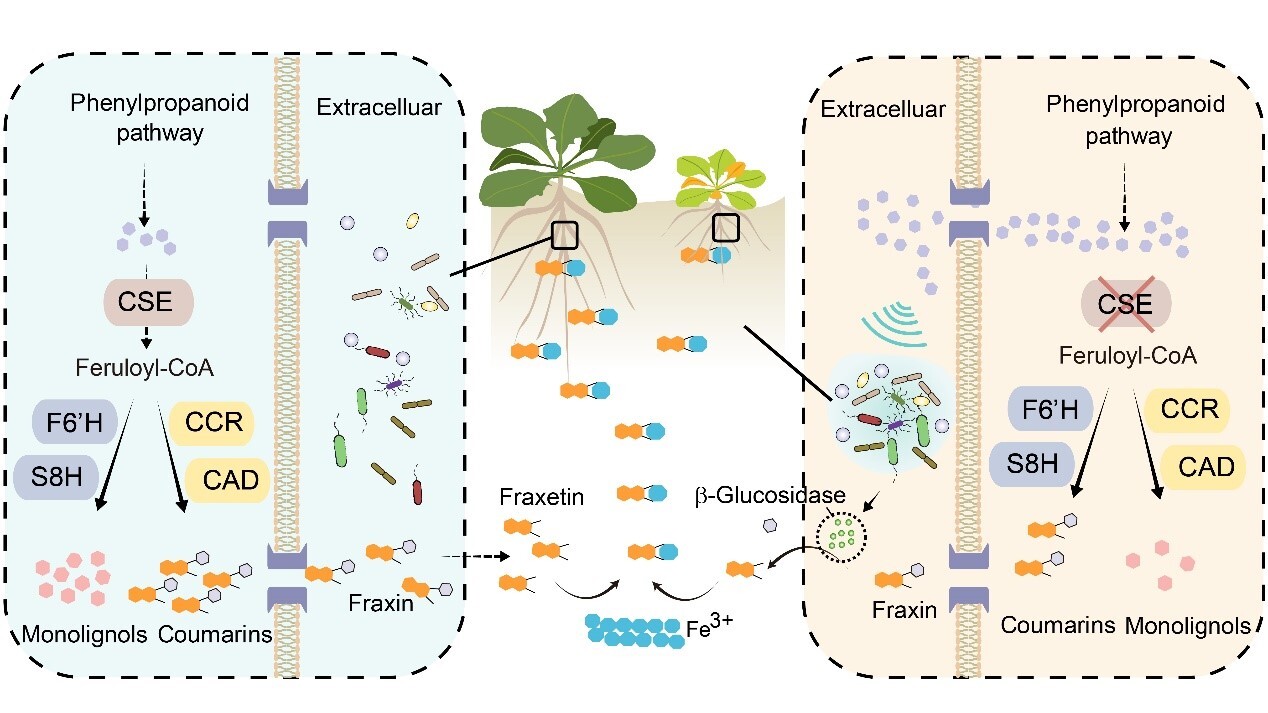
Figure 1. Proposed model of the microbial assembly by aromatic metabolites and the mobilization of ferric iron (Image by IGDB). CSE-depleted mutant recruits root microbes by releasing metabolites upstream of monolignol_ and coumarin biosynthetic pathways. These bacteria can cleavage sugar moieties from glycosylated catecholic coumarin, which increases the concentrations of catecholic fraxetin around roots and mobilizes the ferric iron in alkaline soil. The green dot symbol denotes the enzymatic cleavage of coumarin glycosides by rhizosphere bacteria to release bioactive aglycones.
Contact:
Dr. WANG Guodong
Institute of Genetics and Developmental Biology, Chinese Academy of Sciences
Email: gdwang@genetics.ac.cn
 CAS
CAS
 中文
中文



.png)

