 CAS
CAS
 中文
中文



.png)
-
FUBL-3/FUBP1 Bridges Mitochondrial Stress to Chromatin Remodeling and Longevity
TIME: 24 Jun 2026Mitochondrial stress triggers retrograde signaling to the nucleus, activating protective programs such as the mitochondrial unfolded protein response (UPRmt) to restore homeostasis and promote longevity. While transcriptional regulation of these responses is well-documented, how mitochondrial signals induce large-scale chromatin structural reorganization remains poorly understood.In a study published in Science Advances on June 25, 2026, entitled "FUBL-3/FUBP1 Mediates Mitochondrial Stress-induced Chromatin Remodeling and Longevity," researchers led by Dr. TIAN Ye from the Institute of Genetics and Developmental Biology of the Chinese Academy of Sciences (CAS) identified the nuclear factor FUBL-3/FUBP1 as a key mediator that couples mitochondrial stress to chromatin remodeling.Using a forward genetic screen in Caenorhabditis elegans, the researchers identified FUBL-3 (a homolog of human FUBP1) as a critical regulator of the mitochondrial stress response. Upon mitochondrial disturbance, FUBL-3 expression increases and the protein translocates into intestinal cell nuclei, where it drives NuRD-dependent large-scale chromatin condensation. Loss of fubl-3 abolishes mitochondrial stress‑induced chromatin remodeling, UPRmt activation, and lifespan extension, whereas intestinal overexpression of FUBL-3 is sufficient to induce chromatin condensation and extend lifespan even in the absence of stress.Importantly, this mechanism is conserved in mammals: in human cells, FUBP1 mediates mitochondrial stress‑induced chromatin remodeling and directly binds to the promoters of genes involved in proteostasis and mitochondrial quality control, coordinating adaptive transcriptional responses.This research establishes FUBL-3/FUBP1 as a conserved "mitochondrial-to-nuclear" messenger that reshapes the global chromatin landscape to enhance organismal fitness and longevity. These findings provide new insights into the epigenetic regulation of aging and offer potential targets for intervening in aging and age-related mitochondrial diseases.The study was supported by the National Key Research and Development Program of China, the CAS Project for Young Scientists in Basic Research, the National Natural Science Foundation of China and the New Cornerstone Science Foundation through the XPLORER PRIZE, etc.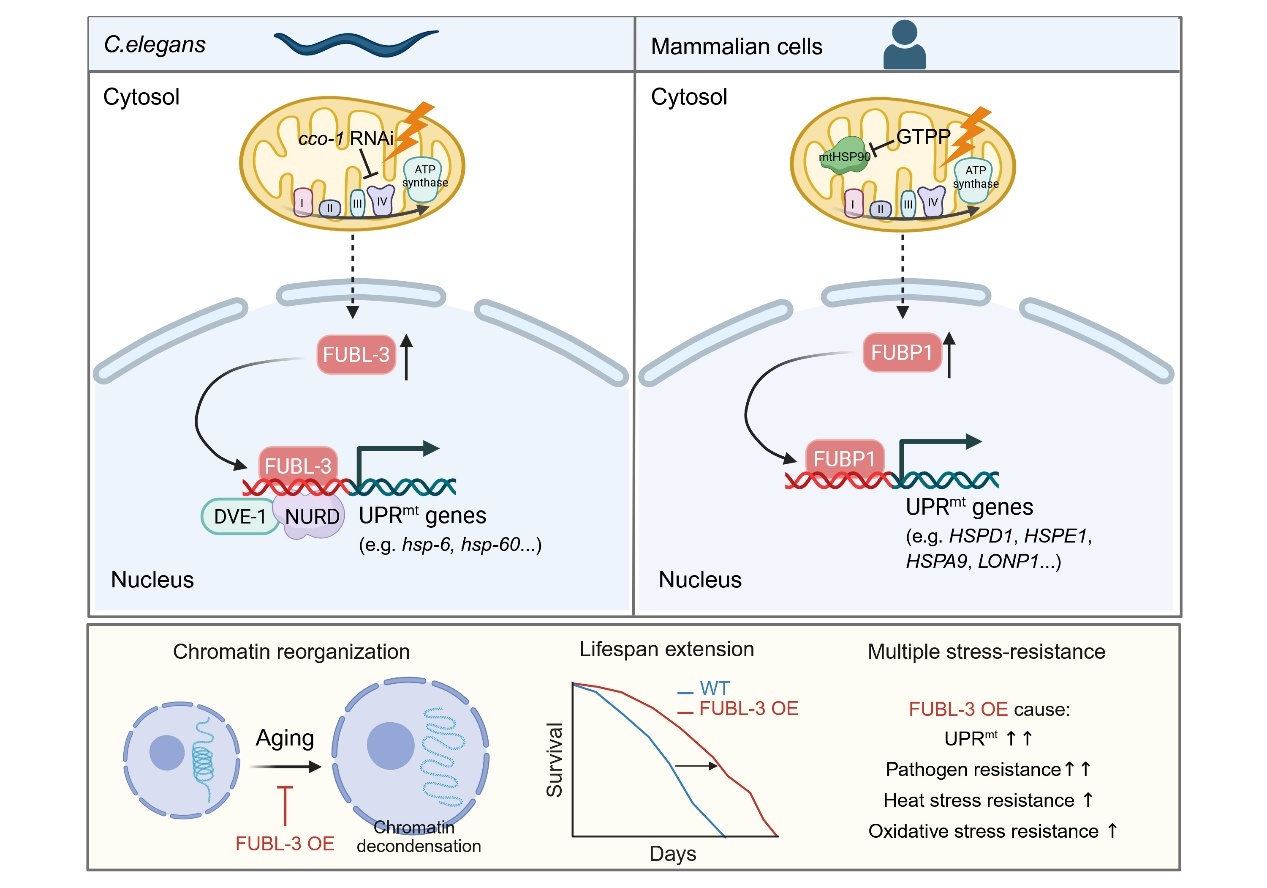 Figure. FUBL-3/FUBP1 mediates mitochondrial stress-induced chromatin remodeling and longevity (Image by IGDB)
Contact:
Dr. TIAN Ye
Institute of Genetics and Developmental Biology, Chinese Academy of Sciences
Email: ytian@genetics.ac.cn

