Seed size is a remarkably plastic trait in flowering plants, ranging from minute grains to large nutrient-rich seeds, and this variation has been central to their evolutionary success across diverse environments. In crops, however, this natural diversity takes on a far more practical significance, as even modest changes in seed size can translate directly into differences in yield. Although many genes influencing seed development have been identified, how plants integrate hormonal information to fine-tune this trait remains poorly understood.
In particular, auxin, one of the earliest discovered and most pervasive plant hormones,has unknown mechanisms linking its signaling to final seed size, a major open question in plant biology.
Recently, a research team led by Prof. LI Yunhai at the Institute of Genetics and Developmental Biology, Chinese Academy of Sciences, has identified a direct molecular link between auxin signaling and seed size control in plants. They revealed how auxin signaling, acting through a phosphorylation-based switch, fine-tunes seed development.
The study was published in Molecular Plant on June 1 (DOI:10.1016/j.molp.2026.05.020).
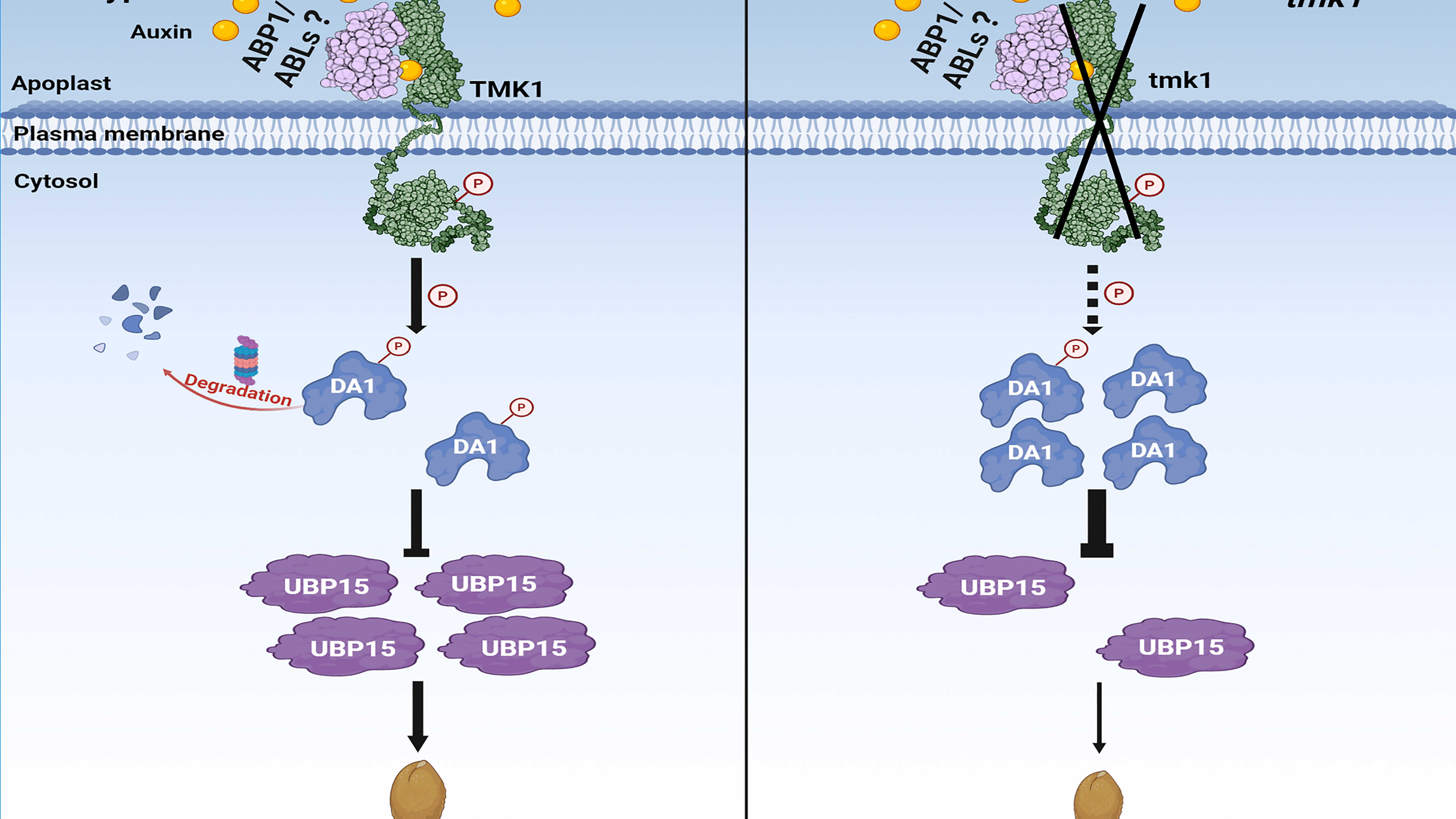
The researchers focused on a plasma membrane receptor kinase, TMK1, known to perceive the plant hormone auxin together with ABP1/ABLs. In Arabidopsis, loss of TMK1 resulted in noticeably smaller seeds, while its overexpression produced larger seeds. Genetic analyses further showed that TMK1 acts redundantly with its homolog TMK4, and that its effect is mainly mediated through maternal tissues, by regulating cell proliferation and expansion.
The key breakthrough came when the researchers traced TMK1’s downstream targets. They identified a protein known as DA1, previously recognised as a brake on organ growth. TMK1 was shown to chemically modify DA1 through phosphorylation, marking it for degradation by the cell’s protein-recycling machinery. Once DA1 is degraded, its inhibitory effect is lifted, allowing the accumulation of UBP15, a growth-promoting factor that drives increased cell proliferation in the seed coat. Auxin itself strengthens this chain reaction, boosting DA1 phosphorylation and tipping the balance towards growth.
Because components of this pathway are conserved in major crops such as rice, wheat and maize, the findings suggest a practical route for future breeding. Fine-tuning this phosphorylation “switch” could provide plant scientists with a more precise means of modulating seed size, with potential implications for improving agricultural productivity.
A proposed model for auxin signaling-regulated seed size through the TMK1-DA1-UBP15 pathway. (Image by IGDB)
Contact:
Prof. LI Yunhai
Institute of Genetics and Developmental Biology of the Chinese Academy of Sciences
Email: yhli@genetics.ac.cn
 CAS
CAS
 中文
中文



.png)
 A proposed model for auxin signaling-regulated seed size through the TMK1-DA1-UBP15 pathway. (Image by IGDB)Contact:Prof. LI YunhaiInstitute of Genetics and Developmental Biology of the Chinese Academy of SciencesEmail: yhli@genetics.ac.cn
