Precise manipulation of large genomic fragments is a critical need in crop breeding and synthetic biology. In crop genomes, superior traits are frequently associated with structural variations such as promoter rewiring, gene cluster rearrangement, and large-fragment inversions or deletions. However, existing large-fragment editing tools face significant limitations. CRISPR-Cas systems rely on double-strand breaks (DSBs), which yield low heritable editing efficiencies (0.03–0.5%) and are prone to indel byproducts and chromothripsis-like aberrant rearrangements. Conventional site-specific recombinases (e.g., Cre, Flp) require pre-installed recognition sites, severely limiting their applicability. In 2024, the bridge RNA-guided IS110-family recombinase system opened a new avenue for programmable, DSB-free, scarless large-fragment genome editing, but its application in plants had not been demonstrated.
Now, a team led by Prof. GAO Caixia from the Institute of Genetics and Developmental Biology (IGDB) of the Chinese Academy of Sciences has developed a bridge RNA-guided recombinase system that enables programmable, scarless large-fragment genome editing across both plant and mammalian cells.
The study was published in Trends in Biotechnology on August 20th.
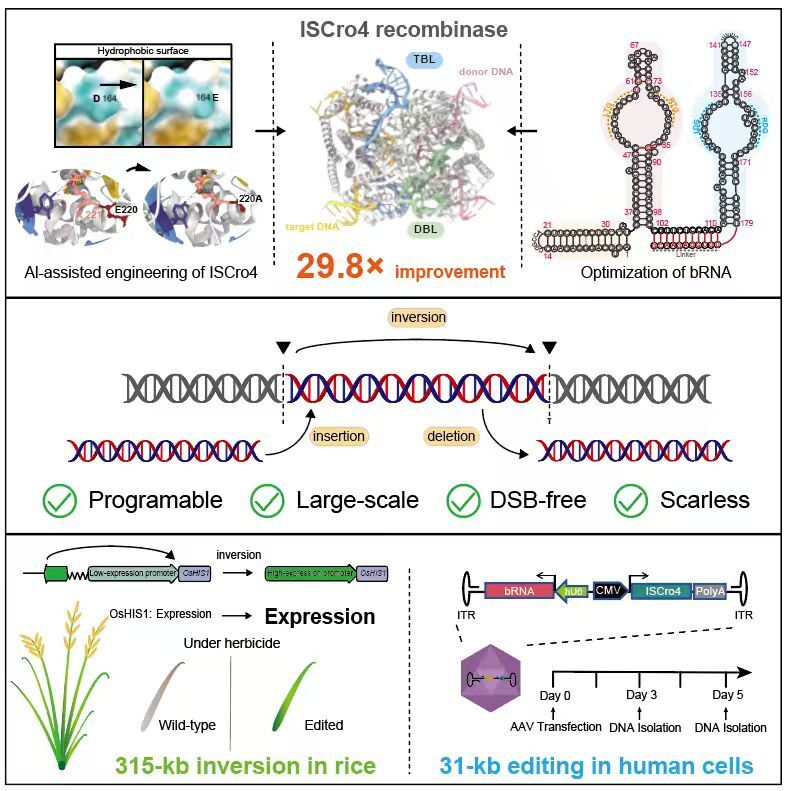
The researchers first evaluated two IS110-family recombinases—IS621 and ISCro4—in plant cells, selecting ISCro4 as the enzymatic core for its robust activity across insertion, deletion, and inversion editing. They then systematically engineered the bRNA scaffold to stabilize the target-binding loop (TBL) stem-loop structure and optimize the donor-binding loop (DBL) conformation, improving editing efficiency by up to 15.3-fold over wild-type bRNA.
Building on bRNA optimization, the researchers leveraged their AI-assisted directed evolution platform, AiCE, to extensively engineer the ISCro4 recombinase. Screening identified two key mutations—E220A and D164E—that stabilize the recombinase-bRNA-DNA ternary complex. Notably, co-optimization of bRNA and the recombinase exhibited striking synergy: the double mutant Rm7 (E220A&D164E) paired with the optimized bRNA_mT6D16 achieved a 29.8-fold overall improvement in activity, reaching 9.4% editing efficiency in rice protoplasts.
In regenerated rice plants, the optimized system mediated precise deletions and inversions of 27–315 kb fragments with stable editing efficiencies up to 23.9%. Through a 315-kb genomic inversion, the researchers rewired a strong endogenous promoter to the OsHIS1 gene, upregulating its expression 15.1-fold and conferring enhanced herbicide resistance. Whole-genome sequencing of edited plants confirmed all intended rearrangements with no detectable off-target structural variations, demonstrating the high specificity of the system.
Exploiting the compact size of ISCro4 (<350 amino acids), the researchers packaged the recombinase together with the bRNA expression cassette into a single adeno-associated virus (AAV) vector, achieving 31-kb inversions and 30-kb deletions in mammalian cells.
Unlike CRISPR-Cas chromosome engineering and conventional recombinase technologies, the bridge RNA system combines reprogrammability with scarless precision, complementing existing approaches. This work establishes a versatile platform for programmable chromosome-scale genome engineering, with broad potential for accelerating precision crop breeding and enabling gene therapy for large-fragment genomic disorders.
Engineering and application of bridge RNA-guided recombinases for programmable large-fragment genome editing
Contact:
Prof. GAO Caixia
Institute of Genetics and Developmental Biology, Chinese Academy of Sciences
Email: cxgao@genetics.ac.cn
 CAS
CAS
 中文
中文



.png)
 Engineering and application of bridge RNA-guided recombinases for programmable large-fragment genome editingContact:Prof. GAO CaixiaInstitute of Genetics and Developmental Biology, Chinese Academy of SciencesEmail: cxgao@genetics.ac.cn
