A soybean plant may look still and quiet, but inside it is constantly listening for danger. Its leaves are exposed to airborne attackers, while its roots meet a different community of microbes in the soil. To survive, the plant needs more than one general alarm.
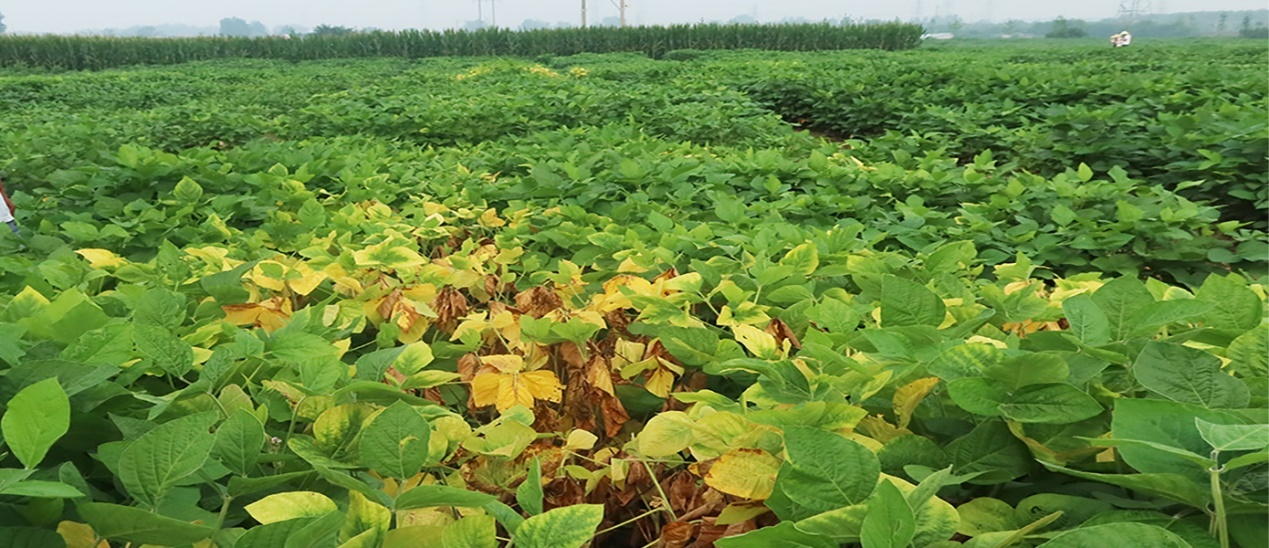
Soybean disease caused by root pathogen (Image by Zhou ZZ, Beijing)
A research Group led by Dr. LI Lei at the Institute of Genetics and Developmental Biology (IGDB) of the Chinese Academy of Sciences has discovered a flexible warning system that helps soybean defend different tissues. The study was published in Nature Plants on August 17, 2026.
At the heart of the system are tiny molecules called peptides. They work like short alarm messages sent by the plant itself. A matching sensor on the surface of a cell receives the message and tells the cell to prepare for attack.
The soybean messages are called GmSubPEPs. They are unusual because they are hidden inside much larger proteins, rather like emergency notes tucked inside a handbook. When needed, the short message can be released and used to activate defense.
The new study builds on the team’s earlier high-throughput work, which created a scalable way to match soybean peptides with their receptors. Using that foundation, the researchers traced the hidden SubPEP signals, identified their receptor partners, and examined how the system evolved across legumes.
The researchers discovered several GmSubPEP variants with very different amino-acid sequences. Despite these differences, each peptide could activate disease resistance, and each showed a preferred place of action. GmSubPEP3 and GmSubPEP4 were especially active in leaves and reduced lesions caused by the fungal pathogen Rhizoctonia solani. GmSubPEP1 and GmSubPEP2 were more active in roots, while several family members improved resistance to the soil-borne pathogen Phytophthora sojae.
The matching receptors, named GmSubPEP receptors (GSPRs), explained how the plant distinguishes these messages. GSPR1 recognized GmSubPEP1 and GmSubPEP2, while GSPR2 and GSPR3 mediated the activities of GmSubPEP3 and GmSubPEP4, respectively. The receptors also showed different expression patterns in leaves and roots, helping to explain the tissue-specific responses.
A further surprise came from the soybean genome. Genes encoding the peptides and their receptors were not scattered randomly. Instead, they were interspersed within the same genomic region, forming a local collection of signals and sensors. Related clusters were also found in other legumes, including Medicago and chickpea.
These results suggest that peptide and receptor genes expanded together during legume evolution. Over time, individual pairs acquired different recognition properties and roles in different tissues. This arrangement may allow plants to preserve a common immune framework while continually generating new, specialized defenses.
The work offers a practical clue for crop research. When peptide and receptor genes occur together, that neighborhood may point researchers toward a functional immune pair. Such naturally matched modules could eventually support disease-resistance breeding, peptide-based crop protection, or engineered immune receptors.
Soybean uses several matched peptide-sensor pairs to organize defense in leaves and roots (Image by IGDB).
Contact
Dr. LI Lei
Institute of Genetics and Developmental Biology, Chinese Academy of Sciences
E-mail: leili@genetics.ac.cn
 CAS
CAS
 中文
中文



.png)
 Soybean disease caused by root pathogen (Image by Zhou ZZ, Beijing)A research Group led by Dr. LI Lei at the Institute of Genetics and Developmental Biology (IGDB) of the Chinese Academy of Sciences has discovered a flexible warning system that helps soybean defend different tissues. The study was published in Nature Plants on August 17, 2026.At the heart of the system are tiny molecules called peptides. They work like short alarm messages sent by the plant itself. A matching sensor on the surface of a cell receives the message and tells the cell to prepare for attack.The soybean messages are called GmSubPEPs. They are unusual because they are hidden inside much larger proteins, rather like emergency notes tucked inside a handbook. When needed, the short message can be released and used to activate defense.The new study builds on the team’s earlier high-throughput work, which created a scalable way to match soybean peptides with their receptors. Using that foundation, the researchers traced the hidden SubPEP signals, identified their receptor partners, and examined how the system evolved across legumes.The researchers discovered several GmSubPEP variants with very different amino-acid sequences. Despite these differences, each peptide could activate disease resistance, and each showed a preferred place of action. GmSubPEP3 and GmSubPEP4 were especially active in leaves and reduced lesions caused by the fungal pathogen Rhizoctonia solani. GmSubPEP1 and GmSubPEP2 were more active in roots, while several family members improved resistance to the soil-borne pathogen Phytophthora sojae.The matching receptors, named GmSubPEP receptors (GSPRs), explained how the plant distinguishes these messages. GSPR1 recognized GmSubPEP1 and GmSubPEP2, while GSPR2 and GSPR3 mediated the activities of GmSubPEP3 and GmSubPEP4, respectively. The receptors also showed different expression patterns in leaves and roots, helping to explain the tissue-specific responses.A further surprise came from the soybean genome. Genes encoding the peptides and their receptors were not scattered randomly. Instead, they were interspersed within the same genomic region, forming a local collection of signals and sensors. Related clusters were also found in other legumes, including Medicago and chickpea.These results suggest that peptide and receptor genes expanded together during legume evolution. Over time, individual pairs acquired different recognition properties and roles in different tissues. This arrangement may allow plants to preserve a common immune framework while continually generating new, specialized defenses.The work offers a practical clue for crop research. When peptide and receptor genes occur together, that neighborhood may point researchers toward a functional immune pair. Such naturally matched modules could eventually support disease-resistance breeding, peptide-based crop protection, or engineered immune receptors.
 Soybean uses several matched peptide-sensor pairs to organize defense in leaves and roots (Image by IGDB).ContactDr. LI LeiInstitute of Genetics and Developmental Biology, Chinese Academy of SciencesE-mail: leili@genetics.ac.cn
