Organisms generally alternate between haploid and diploid phases in their lifecycles; the diploid sporophyte stage produces haploid spores through meiosis, while the haploid gametophyte stage generates gametes. The fusion of male and female gametes during fertilization leads to the formation of a diploid zygote, which subsequently develops into a complex multicellular organism characterized by specialized tissues and organs. A fundamental and long-standing question in developmental biology is how this single cell, through precisely coordinated divisions and fate specification, gives rise to a complete, functional organism.
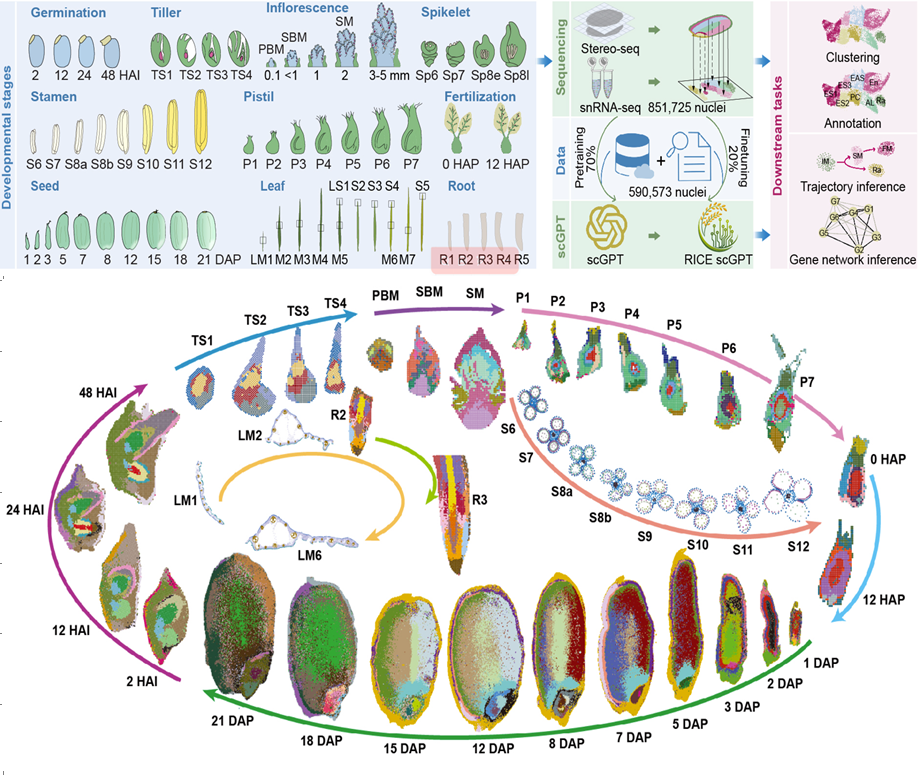
Recently, a group led by Prof. YANG Weicai from the Institute of Genetics and Developmental Biology (IGDB), Chinese Academy of Sciences, in collaboration with several research teams, built a 3D spatiotemporal atlas of rice spanning 10 organs and 61 stages from seed to seed.
They combined high-resolution spatial transcriptomics, single-nucleus RNA sequencing, and a gap-free reference genome to build the datasets which define 119 cell types and 133 subtypes across the rice lifecycle. Through multimodal integration, they reconstructed an inferred developmental trajectory graph that links cell states from the proembryo to mature organs and identifies trajectory-associated regulators.
This work published in Cell titled "A spatiotemporal lifecycle atlas decodes spatial coordination in rice”.
The researchers elucidated that the pleiotropic master regulator OsARF1 achieves multifunctionality through context-specific regulatory networks, and uncovered broad asymmetric gene expression across organs, which defined a novel dorsoventral transcriptional asymmetry in the endosperm and illustrated how spatial expression patterns guide tissue patterning and resource distribution.
To further characterize intercellular communication dynamics, the researchers used PlantPhoneDB to map cell-cell interaction networks among seed cell populations across developmental stages. The seed coat, endosperm, and embryo during seed development follow a highly coordinated yet phased dialogue pattern through key signaling peptides and their receptors. These findings offer a potential resource of ligand–receptor pairs during seed development that could be tested in future studies.
A spatiotemporal lifecycle atlas decodes spatial coordination in rice (Image by IGDB)
Contact:
Dr. JIA Pengfei
Institute of Genetics and Developmental Biology, Chinese Academy of Sciences
Email: pfjia@genetics.ac.cn
 CAS
CAS
 中文
中文



.png)
 A spatiotemporal lifecycle atlas decodes spatial coordination in rice (Image by IGDB)Contact:Dr. JIA PengfeiInstitute of Genetics and Developmental Biology, Chinese Academy of SciencesEmail: pfjia@genetics.ac.cn
