A new gene-editing system could make it easier for researchers to introduce precise genetic changes into crops such as tomatoes, soybeans, and rapeseed. Developed by researchers in China, SmartPE improves prime editing efficiency in several dicot plants, addressing a major limitation of the technique.
The new system introduces mismatches into the reverse transcriptase templates (RTTs) of two prime editing guide RNAs (pegRNAs), combining this strategy with a cis-regulatory element and an engineered reverse transcriptase.
The study, led by Prof. GAO Caixia from the Institute of Genetics and Developmental Biology (IGDB) of the Chinese Academy of Sciences (CAS), was published in Nature Plants on October 28.
Prime editing can install base substitutions and small insertions or deletions without double-strand breaks or a donor template, with relatively few off-target events and byproducts. In dicot plants, however, its efficiency is low and varies widely among target sites.
In this study, the researchers first inserted cis-regulatory elements between the promoter and the Cas9 coding sequence to increase editor expression. The START element performed best, raising transcript levels 2.1-fold and editing efficiency at four Arabidopsis targets by about 1.8-fold.
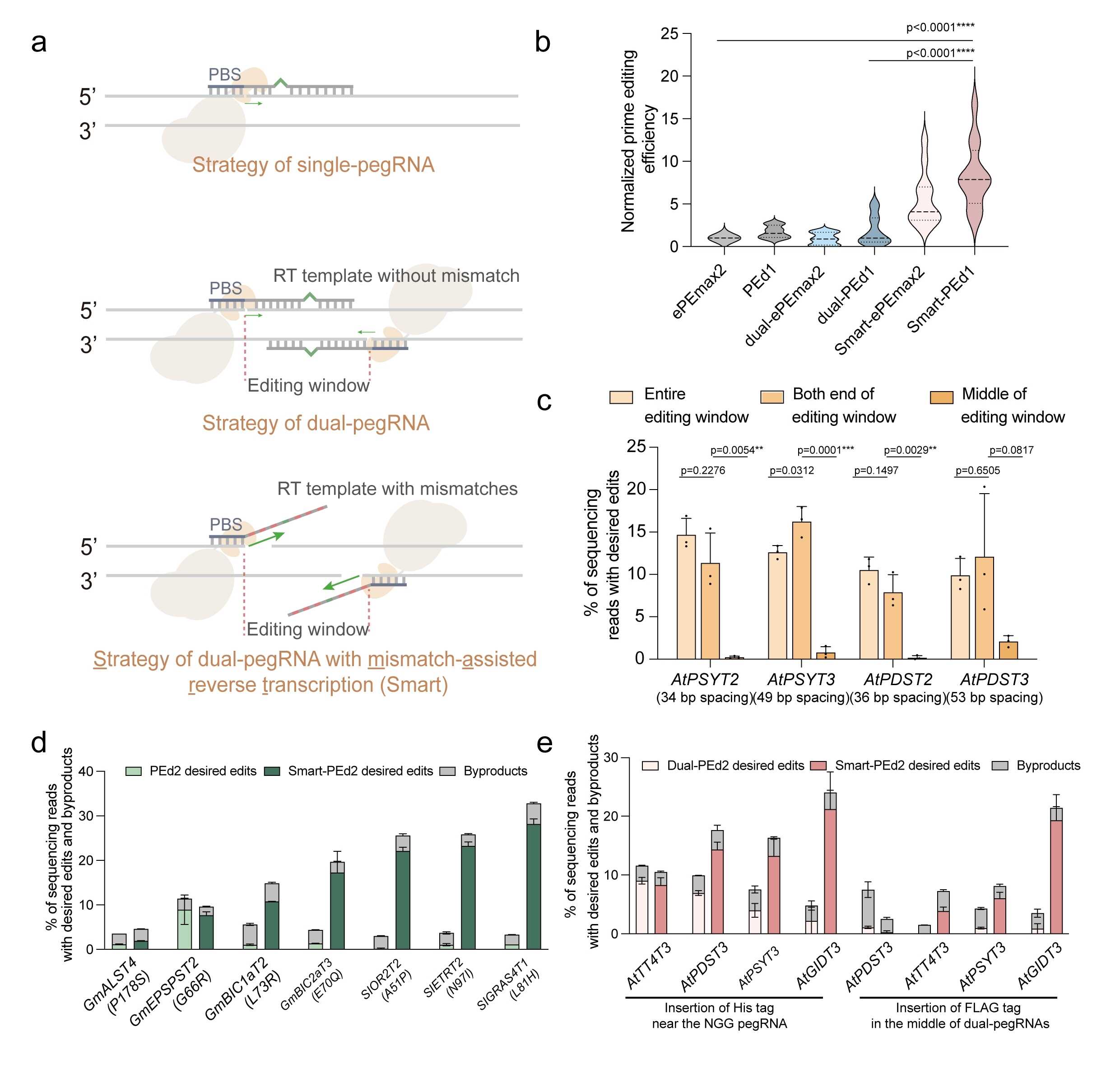
Building on this improvement, the team tested a dual-pegRNA strategy, but editing efficiency did not improve. The researchers reasoned that complementary pairing between the RTT and genomic DNA may hinder reverse transcription and that mismatch repair (MMR) suppresses prime editing.
They therefore introduced complementary mismatched bases into the RTTs of both pegRNAs. This modification increased average editing activity at the four targets more than sixfold, reaching approximately 10%. The resulting system was named SmartPE.
The team further examined how the mismatches should be arranged. Continuous mismatches or those spaced 3 bp apart yielded the highest editing efficiency (up to 20%), whereas intervals of 6 bp or more sharply reduced efficiency. This pattern differed from that observed in single-pegRNA systems.
Mismatches at both ends of the editing window improved efficiency, whereas those in the middle did not, suggesting that mismatch placement may influence the initiation of reverse transcription.
In U2OS and HeLa cells, the MMR-inhibiting SB protein enhanced single-pegRNA editing but not SmartPE. These results indicate that the two strategies rely on different repair pathways, although the underlying molecular mechanism remains to be further elucidated.
In protoplasts, six of nine tomato targets exceeded 10% efficiency, nine of 11 soybean targets exceeded 5%, and five rapeseed targets reached or exceeded about 10%. Conventional prime editing was nearly inactive at some of these targets.
Using synonymous substitutions to create RTT mismatches, the team generated single amino-acid substitutions in soybean and tomato targets at efficiencies 1.6 to 11.1 times higher.
In stable transformation experiments, SmartPE produced homozygous (7.3%) and heterozygous (12.5%) edits at the SlOR2 locus in tomato hairy roots, versus only heterozygous edits (1.0%) and chimeras with standard prime editing. In Arabidopsis and tomato, it achieved seamless FLAG-tag, enhancer, and recombination site insertions at up to 32% efficiency (17% co-editing at two targets). In soybean, only chimeras have been obtained so far, indicating a need for further investigation.
Overall, SmartPE improves prime editing efficiency in several dicot plants, including Arabidopsis, tomato, soybean, and rapeseed. The empirical design principles regarding mismatch density and distribution provide a practical framework for applying prime editors in dicot crops.
SmartPE improves prime editing efficiency in dicot plants (Image by IGDB)
Contact:
Prof. GAO Caixia
Institute of Genetics and Developmental Biology, Chinese Academy of Sciences
Email: cxgao@genetics.ac.cn
 CAS
 中文




 SmartPE improves prime editing efficiency in dicot plants (Image by IGDB)Contact:Prof. GAO CaixiaInstitute of Genetics and Developmental Biology, Chinese Academy of SciencesEmail: cxgao@genetics.ac.cn

