A team led by Prof. FENG Jian at the Institute of Genetics and Developmental Biology (IGDB), Chinese Academy of Sciences, has uncovered a cytokinin–NODULE INCEPTION (NIN) regulatory module associated with spontaneous root nodule formation in alfalfa (Medicago sativa). Legumes normally form nitrogen-fixing nodules in response to rhizobial signals, but alfalfa can also produce spontaneous nodules without rhizobia, providing a natural system for studying how plants initiate nodule development independently of bacterial infection.
The findings were published online in Journal of Integrative Plant Biology on September 29, 2026.
All 68 alfalfa accessions examined formed spontaneous nodules at varying frequencies, and Zhongmu-3 was selected for further analysis. Compared with rhizobia-induced pink nodules, spontaneous nodules were smaller and white, lacked intracellular bacteria and accumulated abundant starch granules. They remained uncolonised after subsequent rhizobial inoculation.
Cytokinin measurements revealed enrichment of trans-zeatin riboside (tZR) in spontaneous nodules relative to adjacent roots, without corresponding increases in other measured cytokinins. Applying tZR or the synthetic cytokinin 6-benzylaminopurine (6-BA) induced structurally similar nodules.
Transcriptome analysis revealed shared activation of NIN and other nodulation-associated genes in spontaneous and cytokinin-induced nodules. Homologues of co-induced genes showed similar expression changes during rhizobia-induced nodulation in Medicago truncatula, indicating that part of a conserved developmental programme can operate without infection. Chromatin analysis further revealed increased accessibility around the cytokinin-responsive element (CE) of the NIN promoter and near the transcription start site. The type-B response regulators MsRR3 and MsRR10 bound the CE region in yeast and activated a CE-driven reporter in Nicotiana benthamiana leaves.
These findings support a model in which cytokinin promotes NIN expression through MsRR3 and MsRR10 to initiate spontaneous nodule organogenesis, providing clues for reconstructing aspects of nodule development in non-legume crops. Spontaneous nodules do not fix nitrogen; establishing functional symbiosis will require additional host factors and effective rhizobial infection mechanisms.
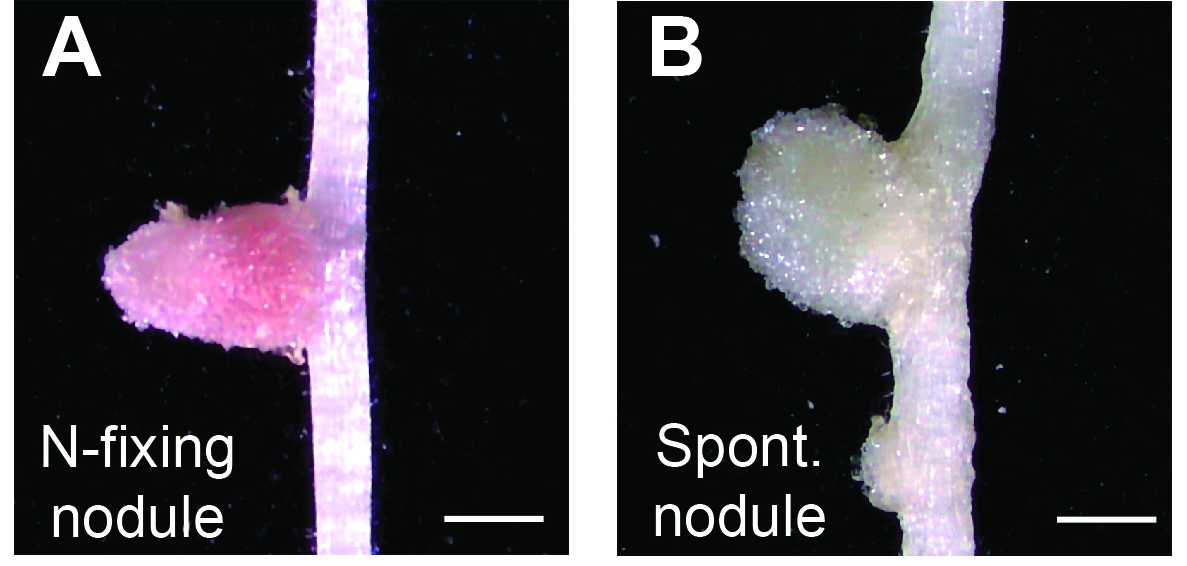
A rhizobia-induced nitrogen-fixing nodule (left) and a spontaneous nodule formed under sterile conditions (right) (Image by IGDB)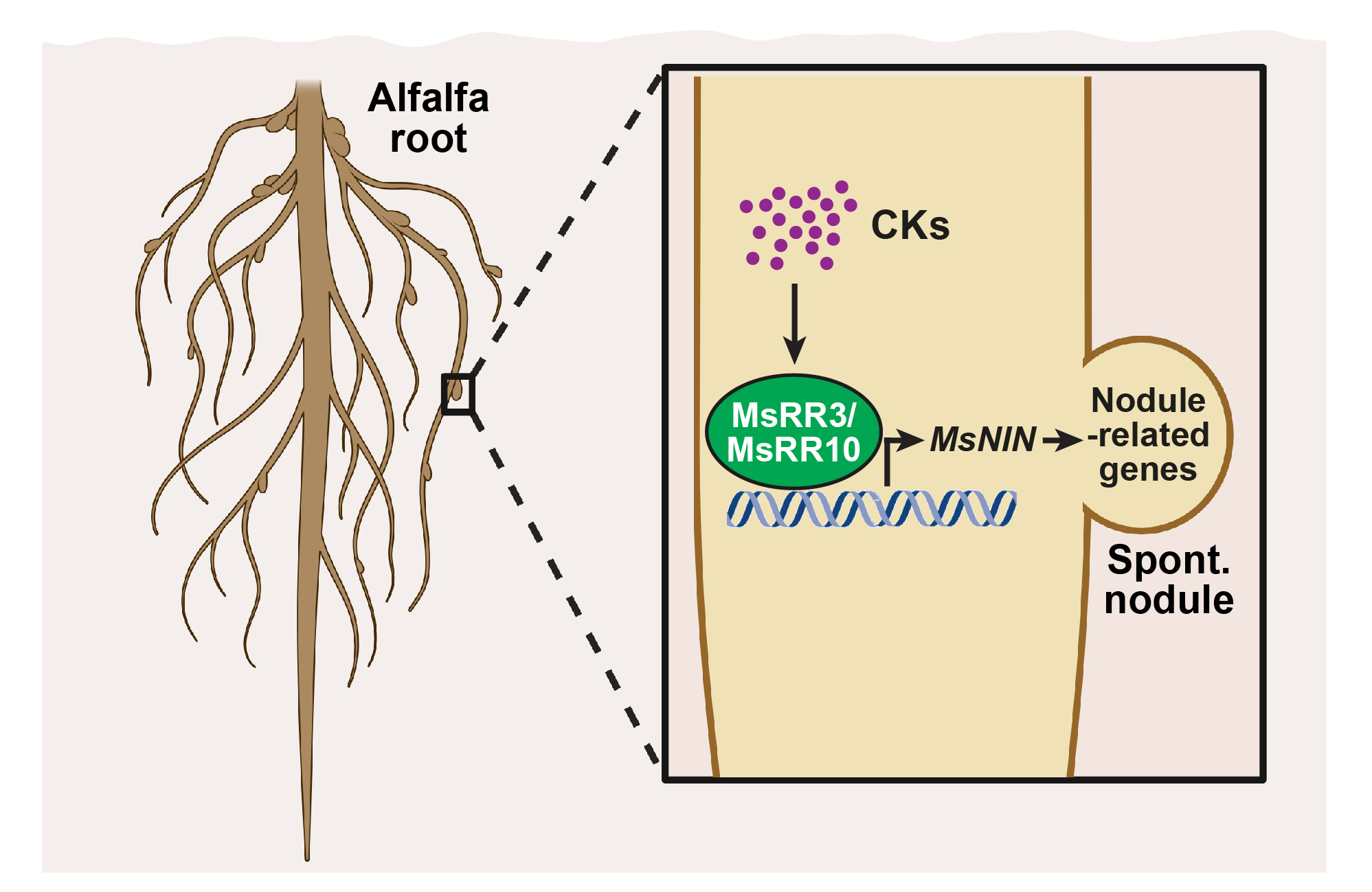
Model of cytokinin–
NIN regulation of spontaneous nodulation in alfalfa. Cytokinin promotes
MsNIN transcriptional activation through MsRR3 and MsRR10, initiating downstream nodule development. CKs, cytokinins; Spont. nodule, spontaneous nodule (Image by IGDB)
Contact:
Prof. FENG Jian
Institute of Genetics and Developmental Biology, Chinese Academy of Sciences
Email: jfeng@genetics.ac.cn
 CAS
 中文





